How compression stockings support leg vein health

Oct 28, 2026

Dr Tan Yih Kai
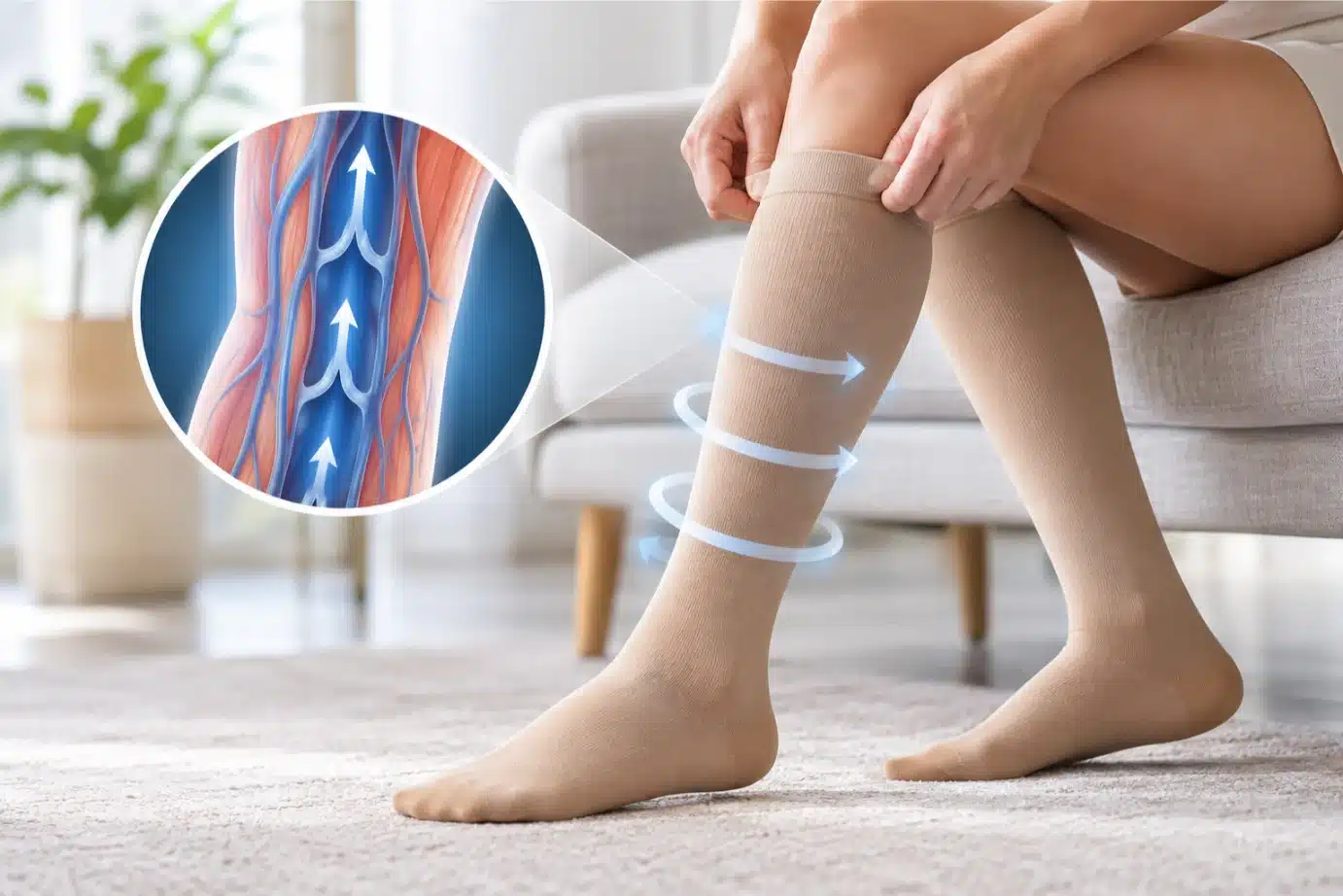
Compression stockings work by gently squeezing your legs, with the most pressure at the ankle and gradually less toward the knee or thigh. This steady pressure narrows stretched veins, allowing their one-way valves to close better, supports the calf muscles that pump blood upward, and reduces fluid leaking into surrounding tissue. The result is better blood return to the heart and less swelling, aching and heaviness.
Key takeaways
- Medical compression stockings are “graduated”: the tightest at the ankle and looser higher up the leg.
- They help veins and valves work more efficiently and support the calf muscle pump.
- They can ease symptoms of varicose veins, chronic venous insufficiency, and leg swelling, but they don’t remove existing varicose veins.
- They aren’t suitable for everyone, especially people with poor arterial circulation, so a doctor should prescribe stronger stockings after a vascular assessment.
- Comfort, the right size, and daily consistency matter more than the brand.
What happens in your leg veins without compression?
Your leg veins have to deliver blood uphill, against gravity, back to your heart. They manage this with two tools: one-way valves inside the veins that let blood travel only upward, and calf muscles that squeeze the deep veins every time you walk.
When veins stretch or valves weaken, blood can flow backwards and pool in the lower legs. This is called venous reflux, and over time it can lead to chronic venous insufficiency, a chronic condition in which refluxing vein valves make it hard for veins to return blood efficiently, resulting in swelling around the ankles, aching, heaviness, cramps, skin hyperpigmentation, and ulceration.
How do compression stockings work, step by step?
Compression stockings counter the pressure build-up from the outside. They do several things at once:
- Narrow the veins. External pressure reduces the width of stretched veins, so blood moves through them faster rather than pooling.
- Help the valves close. When the vein walls are brought closer together, the valve flaps can meet more effectively, reducing backflow.
- Boost the calf muscle pump. The stocking gives your calf muscles something firm to push against, so each step squeezes the veins more effectively.
- Limit fluid leakage. Pressure on the skin and tissue slows fluid movement out of small blood vessels, helping control swelling.
- Guide blood upwards. Because pressure is highest at the ankle and lower further up (graduated compression), blood is encouraged to move up the leg rather than down.
That is why doctors usually recommend putting stockings on in the morning, before swelling has a chance to build up throughout the day.
Who might benefit from wearing compression stockings?
Doctors commonly recommend compression stockings for people with vein-related symptoms or a higher risk of blood pooling in the legs. A doctor may suggest them if you:
- Have varicose veins or spider veins that cause aching or heaviness.
- Have chronic venous insufficiency or recurring leg swelling.
- Have had a deep vein thrombosis (DVT), a blood clot in a deep vein, as part of your doctor’s follow-up plan.
- Are recovering from a vein procedure.
- Are pregnant and experiencing vein symptoms.
- Stand or sit for long hours at work, such as retail, healthcare, hospitality or long-haul travel.
In Singapore, many people in jobs that involve long hours on their feet, from nurses to hawkers and retail staff, notice their legs feel heavier by evening. Graduated compression can help with this daily discomfort, though persistent symptoms should still be checked.
What compression stockings can and cannot do
Compression stockings manage symptoms and support vein function; they do not repair damaged valves or make existing varicose veins disappear. Knowing this helps set realistic expectations.
Compression stockings can | Compression stockings cannot |
|---|---|
Ease aching, heaviness and tired legs | Remove varicose veins that are already there |
Reduce ankle and lower leg swelling | Repair damaged vein valves |
Support healing as part of treatment for venous leg ulcers | Replace medical assessment of new or one-sided swelling |
Lower the risk of blood pooling during long periods of sitting or standing | Treat problems caused by blocked arteries |
Support recovery after some vein procedures | Work well if they are the wrong size or worn inconsistently |
If symptoms continue despite compression, your doctor may discuss other varicose vein treatment options.
Who should not wear compression stockings without advice?
Compression is not safe for everyone. You should get a medical check before using stronger compression if you have:
- Poor arterial circulation, such as peripheral arterial disease. Squeezing legs that already receive too little blood can further reduce blood flow. A doctor may check your foot pulses or measure the ankle-brachial index (a simple test comparing blood pressure at the ankle and arm).
- Diabetes can reduce sensation in the feet, so you may not notice pressure damage to the skin.
- Fragile skin, open wounds or skin infection on the legs.
- Heart failure with significant leg swelling, where extra fluid shifting may need to be managed carefully.
This is why medical-grade stockings with firmer compression are usually fitted after a doctor’s assessment. For details on compression classes, sizing and how often to replace stockings, see our guide to compression stockings for venous diseases.
How can you wear compression stockings comfortably in Singapore’s heat?
Heat and humidity make stockings feel warmer, but a few habits help you stick with them:
- Put them on first thing in the morning, when your legs are least swollen.
- Keep your skin dry and moisturise at night rather than in the morning, so the stocking slides on more easily.
- Ask about lighter or more breathable fabrics and knee-length options, which many people find easier in warm weather.
- Use rubber gloves or a donning aid to help pull them on evenly without bunching.
- Check your skin daily for redness, marks or soreness, especially around the ankle and behind the knee.
- Remove them at night unless your doctor has told you otherwise.
When to see a doctor
See a doctor if you have leg symptoms that are getting worse or not settling, including:
- Swelling in one leg only, especially with pain, warmth or redness. This can be a sign of DVT and needs prompt assessment.
- Sudden breathlessness or chest pain, which needs emergency care.
- Skin changes around the ankle such as darkening, hardening or an itchy rash.
- A sore or wound on the lower leg that heals slowly.
- Numbness, tingling, pale or cold toes while wearing stockings. Remove them and seek advice.
A vascular doctor can identify the cause of your symptoms, usually with an ultrasound scan of the leg veins, and advise whether compression is right for you. Contact The Vascular Vein and Wound Centre to arrange a consultation.
Frequently asked questions
Are compression socks from a sports shop the same as medical compression stockings?
Not always. Sports and travel socks often provide lighter compression and may not be graduated in the same way. Medical-grade stockings come in specific pressure levels and are chosen based on your condition and leg measurements.
How long does it take for compression stockings to reduce swelling?
Many people notice their legs feel lighter within days of wearing them regularly. How much swelling improves depends on the cause, so if it doesn’t settle, see a doctor.
Can I sleep in compression stockings?
Most people are advised to take them off at night, as lying flat removes much of the gravity effect. Some people are given specific instructions after a procedure, so follow your doctor’s advice.
Should I wear compression stockings on a long flight?
Compression stockings may be recommended for people at higher risk of blood clots on long flights. Ask your doctor before travelling if you have had a clot before, recently had surgery or have other risk factors.
Why do my compression stockings roll down or dig in?
This usually means the size or length is not right, or the stocking has lost its stretch. Re-measuring your legs and replacing worn stockings often solves the problem.
This article is for general information only and is not a substitute for medical advice. Please consult a qualified doctor in Singapore for advice specific to your situation.